
New evidence refutes the hypothesis that Lake Cheko is a result of the Tunguska Event
25 May 2023 г.
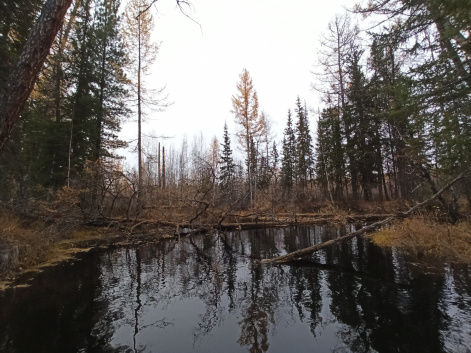
The Tunguska Event took place on June 30, 1908 in the Siberian taiga. It was accompanied by a huge explosion that knocked down trees within a radius of up to 40 km from the epicenter. The cause of the Tunguska Event has not yet been determined. The most common is the hypothesis of the fall of a celestial body. In this regard, attention is drawn to Lake Cheko, which is located only 8 kilometers from the blast epicenter and is considered by some researchers as a trace from the fall of the Tunguska meteorite.
Scientists from Krasnoyarsk, Novosibirsk and Kazan, with the leading participation of specialists from the Federal Research Center "KSC SB RAS", described the bottom morphology and bottom sediments of Lakes Zapovednoye and Peyungda, located in the Tunguska State Nature Reserve not far from the alleged epicenter of the Tunguska Event. The researchers compared the data obtained on Lake Cheko and questioned the hypothesis on the connection between Lake Cheko and the Tunguska phenomenon.
The results show that Lakes Zapovednoe and Peyungda are comparable in shape and depth to Lake Cheko. All of them are round and funnel-shaped. Thus, the shape of Lake Cheko is not unique to the area. Scientists also sampled bottom sediments in these lakes and, using radiocarbon analysis, determined that the age of the Zapovedny exceeds two thousand years. Seismoacoustic studies show that the thickness of the bottom sediments of Lake Peyungda is indicative of the age of several thousand years. The bottom sediments from the Cheko show that the age of this lake must be at least three hundred years. As a result, the age of all three lakes exceeds the time of the Tunguska event. The location of all three lakes in riverbeds also indicates their common origin. These facts testify against the hypothesis of a unique blast origin of Lake Cheko resulting from the Tunguska Event of 1908.
“The unusual shape of Lake Cheko used to be considered unique for the Tunguska region. This fact was one of the main arguments in favor of its blast origin. Our studies of the geomorphology of the bottom of lakes Zapovednoe and Peyungda refute the uniqueness of the shape of Lake Cheko. The similarity of the shape of the three reservoirs indicates their common origin. The difference in the age of the lake sediments calls into question the blast origin of these lakes as this implies the arrival of three almost identical space bodies at different times, which is unlikely, given that the lakes are located almost in the same place on the globe. In addition, all three lakes are located in riverbeds, so the geological nature of their origin is more likely. Presumably, it is associated with karst processes or with the thawing of permafrost, because the shape of the lake basins is looked upon as a consequence of the collapse of the underlying rocks. Thus, we have presented another evidence against the hypothesis of the origin of Lake Cheko being as a result of the Tunguska Event,” said Denis Rogozin, a leading researcher at the Institute of Biophysics of SB RAS, Professor of the Siberian Federal University.
Researchers from the Institute of Biophysics of SB RAS, Siberian Federal University, Kazan Federal University, P.I. V.P. Astafiev Krasnoyarsk State Pedagogical University, V.S. Sobolev Institute of Geology and Mineralogy of SB RAS. The study was supported by the Russian Science Foundation (project no. 22-17-00185).
Earlier, physicists from Krasnoyarsk refuted the fall of the Tunguska meteorite to Earth and calculated that significant destruction in the area of Podkamennaya Tunguska was associated with shock waves which arose during the passage of an iron asteroid through the Earth's atmosphere rather than with the fall of a celestial object.
Share: