
A temperature sensor based on bound states in the continuum has been created
5 June 2024 г.
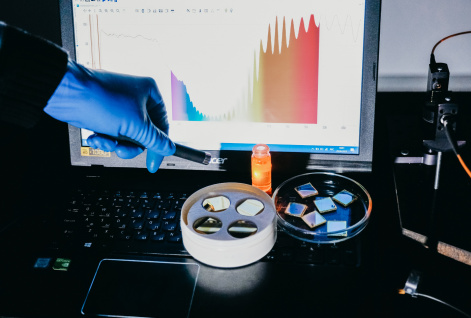
Optical temperature sensors are used in various measuring instruments and control devices in the automotive and chemical industries, oil and gas sector, and other fields. They are employed for temperature control in chemical processes, detection of leaks in pipelines, thermal monitoring of power cables, to ensure fire safety and safe operation of industrial installations.
Scientists from the Federal Research Center "KSC SB RAS" together with colleagues from the Siberian Federal University used the concept of bound states in the continuum to create an optical temperature sensor from a photonic crystal microcavity. The microcavity consists of a liquid crystal layer located between two one-dimensional photonic crystals made of alternating layers of silicon nitride and silicon dioxide.
“We have proposed a new model of an optical temperature sensor based on a microcavity and implemented it experimentally. In our microcavity, photonic crystals act as mirrors, and the liquid crystal layer acts as a resonator layer. When light is between the mirrors, so-called microcavity modes are realized in the liquid crystal layer. To detect temperature, we use the spectral features of localized modes,” said Alexey Krasnov, laboratory assistant at the L. V. Kirensky Institute of Physics SB RAS.
When light passes through the microcavity, dips are observed in the transmission spectra. This dip is called a resonant line, or resonance, which has two main characteristics: spectral position and width. Typically for sensing applications, the position of the resonance changes with temperature changes. Scientists were the first to propose using the second characteristic to measure temperature, i.e. the width of the resonance line. Using the concept of bound states in the continuum, they were able to control the width of the resonance lines when the sample was heated.
“A bound state in the continuum is light which “does not leave” the microcavity. Changing the temperature of the liquid crystal leads to the destruction of the bound state. As a result, light escapes through the mirrors, which is manifested in a change in the spectral width of the corresponding resonance. It is worth noting that for the optical range of electromagnetic waves, temperature control of the width of spectral lines based on bound states in the continuum was implemented for the first time,” explained the research result, a candidate of physical and mathematical sciences, researcher at the L. V. Kirensky Institute of Physics SB RAS, Pavel Pankin.
The device can be used to measure and calibrate temperature.
The study was supported by the Russian Science Foundation (No. 22-22-00687)
Share: