
The stability of new 2D materials can be adjusted by changing the composition of their layers
3 October 2023 г.
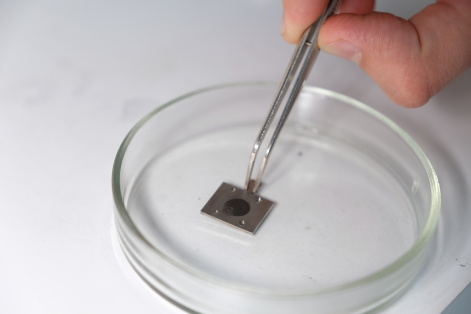
Two-dimensional materials such as graphene have attracted much attention due to their unique properties, which can find applications in electronics, catalysts, sensors, biomedicine and other fields. Recently, scientists from the Krasnoyarsk Science Center SB RAS have developed a new method for the synthesis of two-dimensional nanoflakes of synthetic vallerite and tochilinite, without any impurity phases. These flakes consist of about a dozen stacked monolayers of sulfides and hydroxides. The resulting synthetic minerals have been isolated into a new family of 2D materials with promising but still largely unknown physical and chemical properties.
To understand the specific behavior of the new 2D materials based on vallerite, scientists from the Krasnoyarsk Science Center SB RAS studied the thermal stability and reactivity of synthetic samples of the layered materials represented by “nanoflakes” which are analogues of the natural mineral vallerite. The experiments were carried out in artificially created atmospheres: oxidizing one - with excess oxygen, and inert one.
The study shows that it is possible to somewhat regulate the characteristics by changing the composition of the layers. For example, adding aluminum to the hydroxide layer of walleryite increases its stability and effectively prevents oxidation. It also reduces the iron content in the hydroxide portion and reduces the material's ability to conduct heat. This, in turn, slows down chemical reactions that occur with the absorption of heat, and vice versa accelerates reactions in which heat is released. For example, the presence of aluminum increases the temperature of dehydroxylation (the removal of hydroxyl groups from a substance) to a temperature of about 500 degrees Celsius.
“Previously, we successfully developed hydrothermal methods for producing two-dimensional sulfide-hydroxide materials, analogues of the natural minerals vallerite and tochilinite. In contrast to the formation of these minerals under natural conditions, synthesis in the laboratory makes it possible to finely control the composition and structure of the layers of such materials, which opens up wide possibilities for their practical application. The temperature resistance of the material is an important characteristic which determines the areas of its further application. Therefore, we examined the limits of thermal stability of the synthetic two-dimensional materials with added lithium and aluminum in oxidizing and inert atmospheres. We found that, for example, in an inert atmosphere, the process of material degradation begins at temperatures above 400°C, and up to this temperature the material is quite stable,” said Roman Borisov, Candidate of Chemical Sciences, researcher at the Institute of Chemistry and Chemical Technology of SB RAS.
Scientists were initially inspired to create and study the properties of two-dimensional layered hydroxide materials by naturally occurring ones, namely tochilinite and vallerite, which are found in large quantities in the Norilsk copper-nickel ore deposit, but remain uninvolved in industrial processing due to their structure and properties being insufficiently understood. The study of synthetic materials can also help provide the basis for recycling these minerals.
“We have identified some specific characteristics of 2D layered structures; for example, aluminum and lithium impurities in the hydroxide layers change the characteristics of the material. Information on the stability and reactions of vallerite at elevated temperatures is necessary for many potential applications; In addition, it is necessary for understanding the basic chemistry of two-dimensional layered materials which can have practical implications for mineral processing and metallurgy. The results of this study shed light on the chemical reactivity of 2D vallerite family materials and pave the way for tuning their characteristics. Understanding the structural features, electronic properties and reactivity of materials of the vallerite group can lay the foundation for obtaining high-temperature superconductivity,” concluded Maxim Likhatsky, Candidate of Chemical Sciences, senior researcher at the Institute of Chemistry and Chemical Technology SB RAS.
The research was supported by the Russian Science Foundation (project 22-13-00321).
Share: