
Scientists have discovered a substance that boosts earthworm bioluminescence
1 February 2023 г.
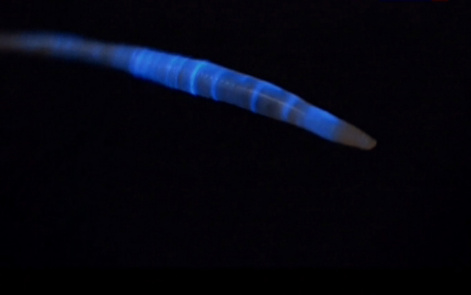
To date, about two dozen species of luminous annelids are known, mostly tropical ones. However, four bioluminescent species were also found in Siberia, including Fridericia heliota and two related species of Henlea: H.petushkovi and H.rodionovae, discovered by Krasnoyarsk scientists. These earthworms are widespread in the Krasnoyarsk Region and Irkutsk Region, and they can be found even in an ordinary garden. The researchers are studying various mechanisms of bioluminescence to be used in the future, for example, for bioluminescent labeling, immunoassays, or even for developing new light sources.
Scientists from the Institute of Biophysics of the Federal Research Center "Krasnoyarsk Science Center of SB RAS" and the M. M. Shemyakin and Yu. A. Ovchinnikov Moscow Institute of Bioorganic Chemistry of RAS previously established that for the worms Henlea sp. to emit light, four main components are required: luciferin, luciferase, calcium ions and oxygen. And now they have discovered two more activating substances that enhance bioluminescence, and identified their structures. One of them turned out to be an analogue of the vitamin riboflavin. Previously, it was found in archaea and bacteria, where this compound was involved in protecting the DNA of microorganisms from ultraviolet radiation. The second activator is a compound which is a sulfate derivative of the first activator - desaflavin sulfate.
Having obtained data on the structures of the activators, the researchers have developed an improved synthesis strategy, which consists of only four steps, and successfully obtained synthetic deazaflavin, which enhances the luminescence of the bioluminescent system of Henlea sp. by three orders.
“The detected bioluminescence activators of Henlea sp. are unusual deazaflavin derivatives. Without them, the emitted light signal is very weak. We assume that the activator is a fluorescent chromophore that absorbs energy after luciferin oxidation and re-radiates it in the visible light range. We have not yet seen this in any bioluminescent organism. The data obtained are important for understanding the operation mechanism of this bioluminescent system,” said Natalya Rodionova, Candidate of Biological Sciences, Senior Researcher at the Institute of Biophysics of FRC KSC SB RAS.
Krasnoyarsk scientists have been studying the bioluminescence of earthworms for many years, in particular, its chemical components and principles of action. And they have already achieved impressive results.
“During the research, our group made several discoveries. Previously, we discovered several new glowworms in Siberia: a species of Fridericia heliota and two related species of Henlea sp. Together with colleagues, we described these species and identified the components of their bioluminescent systems. As a result, a new natural luciferin, which is the eighth in the world list, was discovered for the ATP-dependent system with F.heliota, and they also learned how to produce its synthetic analogue. While studying the calcium-dependent bioluminescence of worms of the genus Henlea, we discovered luminescence activators for the first time. That is, each of these worm bioluminescent systems is unique. But before our research, it was believed that the bioluminescence of earthworms proceeds according to a single peroxide-dependent mechanism. Now there are at least three such mechanisms,” commented Valentin Petushkov, Candidate of Biological Sciences, Leading Researcher at the Institute of Biophysics of FRC KSC SB RAS.
The work was supported by the Russian Science Foundation (21-14-00382).
Share: